



.png)
A few years ago, moving away from Cambridge textbooks was seen as a sign of a progressive approach to teaching. Courses began appearing on the market where teachers gathered materials from dozens of sources, created their own presentations, and promised maximum flexibility without rigid structure.
That freedom often had a downside. Without a unified system, course quality depended entirely on how much time a particular teacher was willing to spend on preparation, how well they selected materials, and whether they managed to update them each semester. For some groups this worked well; for others, it turned into a collection of disconnected exercises with no logic or sequence.
Let's look at the arguments on both sides — and at the solution that takes the best of each approach, using YAPPI corporate English school as an example.
The criticism of printed textbooks is valid for at least three reasons.
First, the printed format is inflexible. Even a textbook designed for business English will be a universal programme for everyone. The needs of a marketing agency, a bank, and an IT team can differ significantly — yet all of them work with the same vocabulary. And that's before considering the entire category of new professions for which printed textbooks simply don't exist: drone operators, demining specialists, critical infrastructure cybersecurity professionals. These roles have emerged or changed dramatically in recent years, and no published textbook has managed to keep up.
Second, the language of business changes faster than new editions are released. Digital marketing terminology, online meeting formats, vocabulary for negotiations and networking — all of this evolves frequently, while a printed textbook is revised at best once every few years. The topic of "email etiquette" five years ago and today already involves a noticeably different set of phrases and constructions, especially given how business communication changed after the shift to remote and hybrid work.
Third, a typical textbook doesn't account for a specific company's context. It teaches, in effect, the "average student." A general business English course won't include scenarios tailored to your department or your team's specific tasks — yet that's exactly what companies are increasingly asking for when they want to teach employees English for concrete work processes.
At the same time, many language schools still prefer traditional textbooks — and for good reason.
The most obvious advantage is structure. A textbook provides a logical progression of material: difficulty increases gradually, grammar and vocabulary are revisited at precisely the moment the student is ready to absorb them, not at random.
In addition, quality textbooks go through multi-stage methodological and editorial review, backed by reputable international publishers with established expertise in language education — working with methodologists, linguists, and editors. These materials are tested on large groups of real students and have demonstrated pedagogical effectiveness.
Another important factor is cost. Ready-made certified textbooks are significantly cheaper than developing a custom curriculum from scratch, making them an accessible option for smaller language schools or self-employed teachers.
Abandoning structured material entirely is the opposite extreme — and comes with its own risks. In the corporate market, you sometimes encounter an approach where the entire programme is built exclusively on teacher-created content. In the short term, this can be effective. For instance, when a teacher quickly tailors topics to a team's needs and uses current cases to prepare for a specific company event.
This flexibility is precisely what underpins YAPPI's ESP courses (English for Specific Purposes) — mini-programmes of 5–14 lessons tailored to a specific role or field, where real work cases, phrases, and templates for emails, calls, and meetings are practised from the very first lesson. This format can be delivered as a standalone or added as a practical block to core corporate training. The subject matter can vary enormously — from English for Miltech & Drone Engineering to English for AI-Driven Design. That's the strength of a no-textbook approach: when a team needs to quickly address a narrow, clearly defined need, flexibility wins over structure.

In the long term, however, learning without a textbook can easily become a chaotic collection of topics — and the teacher ends up spending enormous amounts of time creating lesson programmes from scratch. Think about the students too: one week the group works on presentation vocabulary, the next week a grammar topic with no connection to the previous one, and a lesson later the teacher decides to revisit something covered a month ago because it seems "it didn't stick." Students have no way to understand where they are in the material or how much remains.
And back to the teacher: if they prepare everything independently each time, course quality becomes entirely dependent on their experience, inspiration, and preparation time on any given day. One week the lesson is rich and structured; the next, it's cobbled together from materials found an hour before class. This isn't a question of individual diligence — even the most experienced teacher cannot single-handedly cover the volume of information needed to properly develop an entire course. That's why the entire YAPPI Publishing House works on each company's individual programme, allowing for a depth of development that scales.
In other words, learning entirely without a textbook is in practice no less problematic than choosing an outdated printed one. In both cases, the team loses either flexibility or structure — and in the corporate world, you need both.
Given everything above, we propose shifting the question from "is a textbook an outdated format or a necessity?" to "what textbook format actually matches how modern corporate teams learn?"
The resolution to this tension lies in a format that combines the advantages of both approaches. That's exactly how YAPPI corporate English school approached the creation of its own digital textbook, yBook.

yBook preserves what people value in a traditional textbook:
Each level aligns with CEFR standards, and the material is structured so that students move from simpler to more complex content without chaotic jumps.
At the same time, yBook offers flexibility that printed editions simply cannot match.
Content is updated in real time, so students never encounter outdated topics or irrelevant vocabulary — a team of methodologists, teachers, authors, and editors continuously monitors how both the language and the working context of corporate students evolve. An additional advantage is the ability to tailor the programme to a company's industry, integrating specialised vocabulary modules into the core business English curriculum.
YAPPI has already developed a wide range of courses for different sectors, including banking, game design, healthcare, accounting, the military, and more. Importantly, materials are accessible from any device and any location with an internet connection — allowing students to work through missed lessons independently without falling behind the group.
YAPPI courses are built on a flipped classroom model: students work through pre-class materials in yBook before the lesson, so time with the teacher is spent entirely on practice, communication, and working through real professional cases. After the group session, students can consolidate material in the Extra Practice section and develop specific skills using the Smarte+ vocabulary and grammar trainer — meaning the learning cycle doesn't end when the lesson does.

For those with extra time and a desire to speak even more, YAPPI speaking clubs offer a separate practice format outside the core programme. The concept is simple:
This is another example of how the ecosystem around the textbook operates not just during lessons, but creates constant access to language practice for those who want more English than the standard timetable provides.

If you think pronunciation can't be worked on independently — you simply haven't met yBook's newest feature yet. A built-in AI pronunciation checker is integrated directly into lessons. The student records themselves reading a given text, and the AI compares the recording against standard English pronunciation, immediately showing a quality score and highlighting specific problem areas. This means feedback is available instantly, without waiting for a dedicated lesson with a teacher.

One of the most important aspects of language courses is the ability to track progress. In the yBook digital textbook, each student can see their personal statistics: overall percentage of material covered and a breakdown by individual lesson.
So that learning progress can be seen in numbers rather than just heard in words, personal managers and HR teams can monitor their team's performance through the company representative account in the yCloud ecosystem.

How often do companies ask specifically for customisation to their industry? According to YAPPI's data, one in five companies comes with a request for personalised training. This means fully-fledged work with highly specialised vocabulary and real industry work scenarios: role-play tasks, typical situations, specific terminology. If a programme is being created for a particular department or team, it can be developed under NDA — such courses remain unique and are not shared with other companies, which is particularly important for businesses with sensitive information about internal processes.
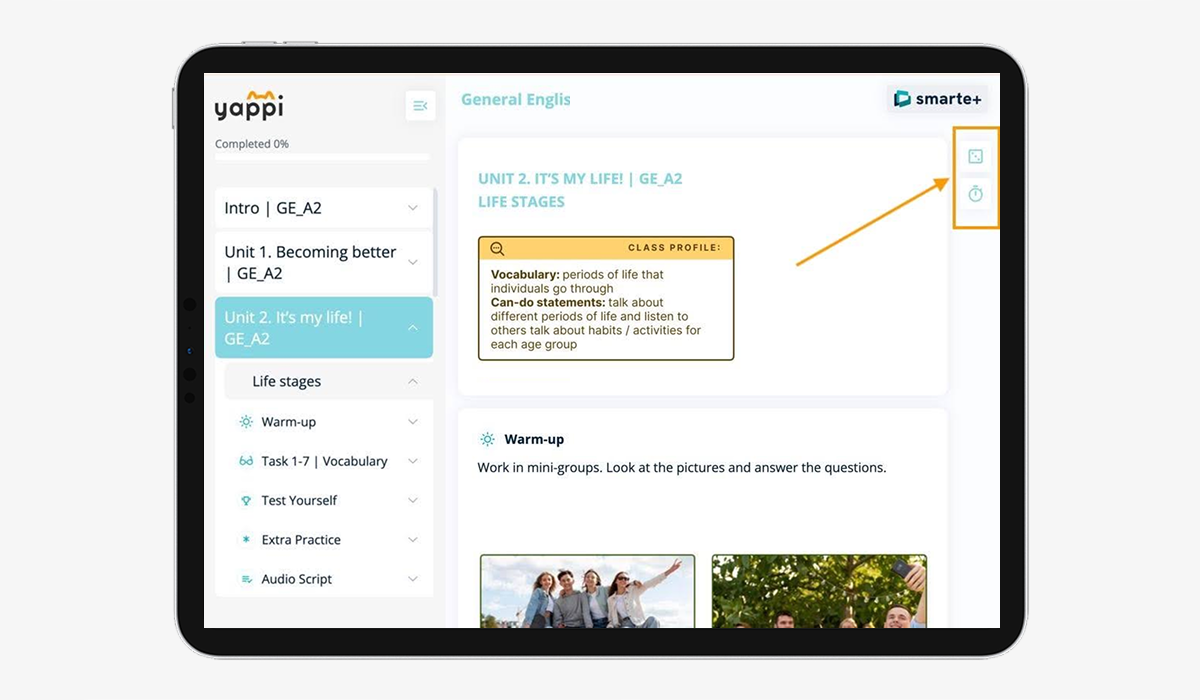
One more practical detail worth mentioning: yBook has built-in tools for in-lesson game activities — digital dice for board games and speaking tasks, and a timer with adjustable minutes and seconds. These small features remove the need for teachers and students to search for third-party apps or physical props, allowing everyone to focus on language practice itself.
So yes — the outdated printed format is genuinely poorly suited to corporate English training, where the pace of language change and business specificity matter. But abandoning structured material entirely in favour of unconstrained flexibility creates its own problems: lack of coherence, total dependence on one teacher, and difficulty measuring outcomes for businesses investing in their team's development.
The best solution is a digital format — like yBook — that brings together the discipline of a structured course with the personalisation that modern corporate learning demands: regularly updated content, industry-specific customisation, instant feedback, and transparent progress tracking.