




After 18 years on the Ukrainian educational market, we know one thing for sure: custom-made materials aren't just a nice-to-have. They're an essential part of delivering truly effective English training.
At YAPPI, every single lesson is created by our in-house team — from scratch. This creative process didn’t come together overnight. It took time, testing, and lots of real-world feedback. But thanks to the daily experience we gain with our clients, our materials are constantly evolving.
It all started with occasional client requests for custom trainings or one-off lessons. Today, we're capable of building full textbook series for all levels — complete with trial lessons, level testing, spaced repetition features, homework options, and more.
Want some numbers to get a feel for the scale of our creative lab?
Between 2023 and 2024, we developed full Business English and General English textbooks for Intermediate to Advanced levels — totaling 372 lessons. That’s just the core content. In addition, we created dozens of tailored programs upon request: Military English, English for Hosting, English for IT, English for Game Artists and more. Add to that over 100 grammar and business training modules, 300+ conversation course lessons, and 400+ mini-lessons covering niche professional vocabulary.
Every lesson at YAPPI starts with an idea: what course it belongs to, what the program looks like, how long it will run, and what level it’s aimed at. From the start, we think about the student — their experience, schedule, and even where they might be six months or a year from now, once the course is up and running.
Then comes the heart of it all: building the course content and finding the right context. We steer clear of the usual suspects like Steve Jobs bios or bland dialogues between John and Mary. Our students are adults — not kids. They’re curious, critical, and can sense when something’s off.
“Adults have a radar for what’s real.”
Next, we move on to planning the individual lesson. Sometimes it starts with a meeting between the editor and the author, where we outline the entire flow from A to Z. Creating a single lesson might take a day — or a full week. It depends on the complexity and depth.
For certain specialized courses, we bring in field experts to consult. For example, our Military English course was developed with input from several military professionals.
Another key step? Editing. Every lesson goes through careful review. The author gets feedback, revises, and resubmits. Sometimes, multiple rounds of edits are needed. On rare occasions, a lesson might be rewritten from scratch — usually when we’re just starting to work with a new author.
The final touch is design. We package the lesson visually, add it to the textbook, and voilà — it’s ready to use with students.
Curious to see how this all looks in real life? Check out our open-access lesson “How does it work?” for Intermediate level — and test our online platform while you're at it!
Up to 10 specialists can be involved in creating a single lesson at YAPPI. Here’s who makes it happen:
Our team of creative authors also work as teachers — but it’s important to note: not every teacher can write materials. That’s a skill on its own. One of the biggest myths in ELT (English Language Teaching) is that if you know English, you can teach it — and if you can teach, you can write a textbook.
But no — a translator is not a teacher, a teacher is not a methodologist, and a methodologist is not an author. These are separate roles, each requiring unique skills and training. In Ukraine, most university programs don’t prepare you to teach English to adults — and they certainly don’t train you to become a materials developer.
We started out encouraging teachers to create their own materials in any format they could — any creative spark was gold. Now, we’re at a stage where we can actually train our authors. We offer video tutorials, ongoing support from editors, and feedback at every stage of the process. And there’s another layer — the tech side. Our interactive platform, Smarte+, is where all the materials live. Authors need to be trained to use it properly. Behind this part of the process stands a separate team: a technical editor and a platform designer.
Today, our R&D department is like a busy kitchen — full of specialists, creators, and master chefs working together to cook up great lessons.
Each lesson at YAPPI goes through multiple stages — and multiple filters — before it reaches a student. Here’s what that process looks like:
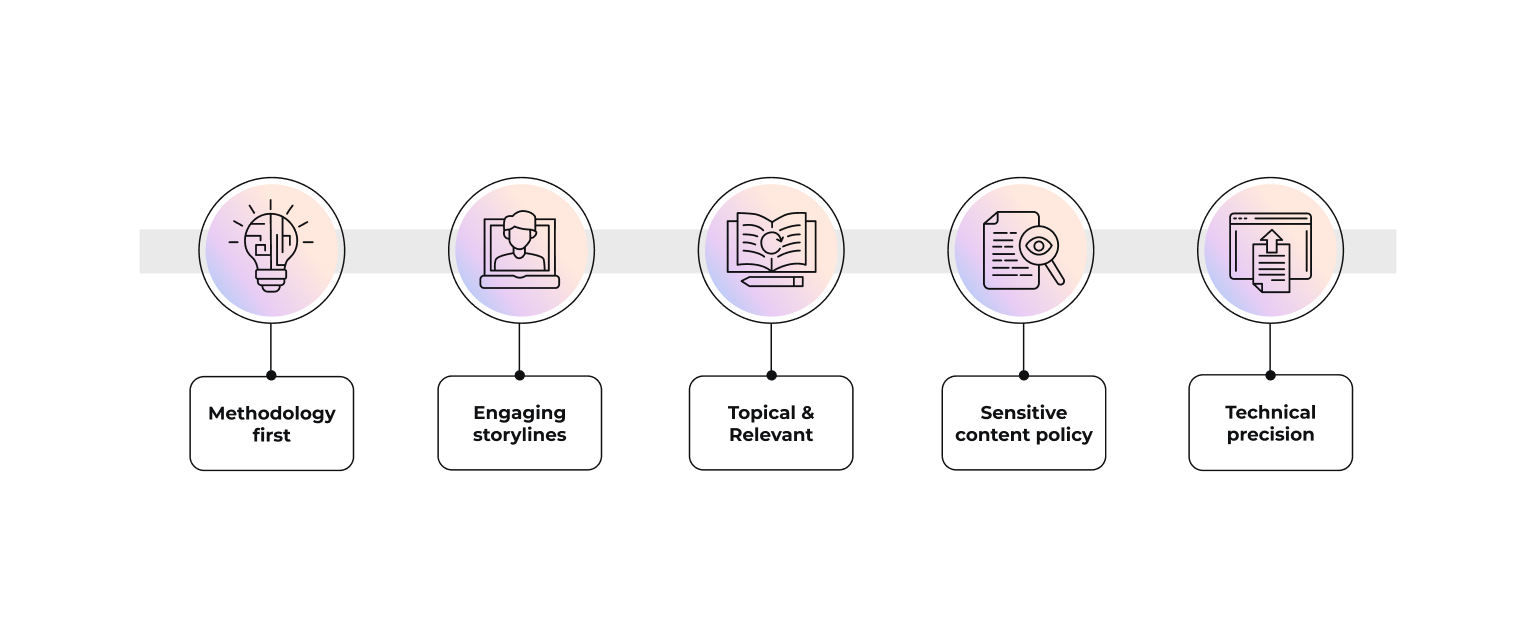
Every lesson must follow the communicative approach — no exceptions. This means real-life contexts, active student engagement, and a clear focus on communication.
The storyline of a lesson is just as important as its vocabulary or grammar goals. Our adult students come with experience and critical thinking — and they’re not easy to impress. So we don’t just give language, we wrap it in real, thought-provoking stories.
Relevance is key. We avoid outdated examples or overused references. Sometimes, we create lessons just days or weeks after a major world event — which means our textbooks often double as current affairs guides.
After the full-scale war in Ukraine began, we recognized the importance of inclusivity. By 2023, themes like Urban Inclusiveness appeared in our yBook course materials.
We don’t allow content that promotes or implies discrimination — including ageism, sexism, homophobia, or any kind of bias.
We also strictly avoid any references to Russian or Belarusian culture, public figures, or content associated with the aggressor country. That includes avoiding quotes or stories from artists who support the war.
All our textbooks are hosted on an interactive platform. But we treat digital lessons with the same rigor as traditional print materials. Fonts, colors, formatting — everything is checked by our technical editors before going live.
The process doesn’t stop once a lesson is published. We regularly update content if the world changes — replacing outdated stats, updating names or timelines, and sometimes rewriting full lesson blocks to keep things fresh and relevant.
At YAPPI, our programs focus on the two most in-demand language skills today: speaking and listening. We keep our finger on the pulse of social change and evolving learner needs. Our lessons blend elements of gamification, the lexical approach, and — most recently — AI integration. We were among the first in the industry to adopt ChatGPT back in late 2022. While AI hasn’t replaced our authors, it has definitely helped us speed up content creation and enhance lesson quality — especially with voiceover and pronunciation tools. Today, our textbooks even include an AI pronunciation checker students can use directly in their lessons.
“We change every time we interact with someone else.”
This quote defines how we see education. Our materials are more than just content — they are tools of human interaction. That’s why we design lessons to inspire, motivate, and uplift. Between the grammar points and vocabulary sets, you’ll find stories that:
This is the unspoken mission of our materials: not just teaching English, but shaping mindsets — and reflecting the spirit of our time.



Organizing corporate English training for a team involves dozens of large and small tasks that consume countless hours of HR specialists’ working time:
At YAPPI, we suggest delegating all of this to our key account managers. What they handle and how they support your team’s learning process — we’ll explain below.
When ordering corporate English courses, it’s important to understand the key steps your team will go through during the training launch.
At YAPPI, we follow a clear process:
Launching a corporate English program doesn’t have to be stressful. Just provide us with the necessary input, and your dedicated manager will handle the rest.
Working with students is always a challenge — even when it comes to corporate training for adults. Someone gets sick, someone forgets about the class, another resists doing homework, and someone else simply refuses to speak during lessons. That’s when it helps to have someone who can handle it all smoothly — so well, you won’t even notice the bumps along the way.
To launch a training project, all you need to do is clearly define your request and confirm the course start. We’ll take care of everything else.
That’s why the YAPPI team includes managers, accountants, developers, and other specialists who handle all administrative, organizational, and financial tasks. What might be a problem for HR — is just part of our daily workflow.
Each project manager is supported by a methodologist who coordinates teachers and ensures that the learning materials align with your company’s needs. Our content creators customize the curriculum for each group. If you’d like to include internal scripts or industry-specific vocabulary, just let your manager know — they’ll pass the request to our content team.
We also handle the selection of instructors tailored specifically to your project. However, you’re welcome to ensure your employees are in good hands:
In other words, the manager acts as a bridge between the school’s teachers and your employees. They ensure smooth and clear communication and are the first person to contact when something doesn’t go as planned during the training process.
You can also think of your personal manager as your HR assistant or right-hand man. Need to clarify an employee’s level, pause classes, or adjust the schedule? Just let your manager know — and it’ll be taken care of.
Throughout the day, your manager may switch hats — from system administrator to financial coordinator, and sometimes even to psychologist. If listening to frustrations helps your training project succeed, they’re ready to listen.
After the trial lesson, throughout the semester, and once it ends, our managers collect student feedback — not just about the course itself, but everything surrounding it. You can view this feedback directly, so there’s no need to run separate internal surveys. Plus, managers stay active in group chats with instructors, keeping a finger on the pulse of student satisfaction.
We care less about five-star ratings and more about honest, unfiltered feedback. That’s what helps us improve our digital ecosystem, refine existing programs, create new ones, and update our coursebooks.
Our long-term partnerships and messages like “Can we launch another group?” are probably the best signs that everything’s working as it should. Want to join us? Leave your contact info for a quick brief or consultation.

When a company looks for a training provider, the price often becomes the deciding factor — especially on public tender platforms, where cost may be listed as the primary or even the only selection criterion. In such cases, the system may automatically award the contract to the cheapest option.
But focusing solely on price — without analyzing the full picture — can lead to hidden costs and serious setbacks. Instead of saving money, companies might end up spending more in the long run. Worse, employees may feel frustrated by poor-quality training and demotivated by the wasted effort. After all, language learning, especially English, isn’t just about grammar and vocabulary — it’s about psychology, motivation, and personal growth.
For many professionals, deciding to improve their English takes deep internal commitment. It’s that powerful “This time, I’m doing it for real” moment. A poor choice of provider can break that momentum.
So what should HR professionals actually look for when choosing a corporate training provider? Drawing from their real-world experience, Vitaliy Vasiliev, CEO of Yappi Group, and Iryna Lyalenko, Head of Client Relations at YAPPI, share practical insights for making the right call.
When a company needs to purchase a service, it usually follows one of two paths:
The first option often seems easier and less resource-intensive, which is why it’s more commonly used. However, it comes with challenges: operators may submit proposals late, or present overly polished marketing offers lacking real substance. In this case, the quality of your tender request or comparison table significantly impacts the relevance and clarity of the responses you receive.
Once the proposals are in, the company typically evaluates them through several key departments:
The direct stakeholder (e.g., the department head or HR) may emphasize quality and relevance, while the procurement team’s goal is to minimize spending and secure the most cost-effective option. At this stage, the most persuasive case usually wins.
Let’s take corporate English training as an example. As HR, you may clearly understand the value of investing in quality language education — not only for skill development but also for employee motivation and engagement. However, to get buy-in from procurement and leadership, you’ll need to make a strong, evidence-based case for the cost.
Of course, most companies consider basic factors like price, range of services, provider reputation, and client reviews. But some critical elements often go unnoticed — and they can make or break your training initiative.
✓ Provider specialization
Here’s your first essential tip:
If you’re looking for corporate English training, choose a provider that specializes in corporate English. Simple, right? Yet it’s one of the most overlooked points during the vendor selection process.
When evaluating dozens of providers, it’s easy to get distracted by impressive portfolios. But beware: if a provider offers English for kids, conversational courses for adults, Hindi lessons, and corporate English — chances are, their programs are generic and not tailored for the specific needs of a business environment.
Such a “one-size-fits-all” approach often means the content is adapted only slightly for different audiences, making it difficult to customize for your company’s industry, team goals, or communication context.
✓ Training program flexibility
Another essential factor to consider from the start is the structure and adaptability of the training program. It’s important to know whether the provider can tailor the curriculum to your employees’ specific needs.
A green flag:
Want to know if a provider is more than just a smooth talker? Ask them to modify their proposed program. A reliable training provider will adjust the curriculum before the training even begins, and will show you what the learning experience actually looks like.
✓ Teachers
Consider their experience specifically in teaching business English to corporate clients in group formats. If a teacher has 10 years of experience, but only with school children, they likely won’t be a good fit for your employees — especially not for your company’s top management.
Also pay attention to the teachers’ certifications. It’s important to understand that the services of professionals who invest thousands of dollars and a great deal of effort into self-improvement and developing their professional skills cannot be cheap. In addition, it’s important that the provider has its own system for improving the qualifications of its teachers. Don’t hesitate to ask what that system looks like and how it works. If such a teaching center exists, the provider will gladly share the results of its work.
Find out what kind of contracts the provider has with its teachers:
Do they have stable workloads over a long period, or are they recruited only for specific projects (i.e., just to launch a group)? This is a key point. To select a teacher who suits your needs in terms of level, specialization, and experience — and to ensure an equal replacement if needed — the provider must have a well-established recruitment and training system, and cooperate with a large pool of trusted teachers.
If you are considering hiring a teacher without going through a provider, weigh the pros and cons. Yes, it will be cheaper. But such a teacher may not always be able to adapt the program to individual company needs. That requires specialized expertise and technological solutions to organize the learning process effectively. Not every freelance teacher has the ability to present material in an interactive digital format, so they often rely on free available resources (e.g., Liveworksheets with PDF textbooks). That’s exactly why major schools have whole development departments for this.
A teacher must have a clearly structured curriculum, which is usually based on a textbook. Therefore, they can’t modify it completely — doing so would break the course logic. In this case, you can only count on the use of additional materials.
✓ A learning platform
Today, this is a must-have, as a learning platform significantly accelerates, simplifies, and enhances the overall quality of the training process. And we’re not talking about simply using a video conferencing tool for online lessons — we mean a fully adaptive platform with an interactive textbook and a personal student dashboard.
A tip:
I can recall a case where a provider successfully passed the client’s technical requirements and even won the tender. However, during the actual training process, it became clear that they had no learning platform, no proprietary textbooks, and no qualified instructors. So here’s the lesson: Don’t just check whether a provider has a certain tool — evaluate whether it meets your needs, and whether it offers the right functionality and flexibility. Otherwise, you might end up in a situation straight out of the “expectation vs. reality” meme.
A learning platform also requires ongoing support and maintenance. For example, at YAPPI, the yCloud platform is continuously developed by a dedicated team. This department is responsible for improving, adapting, and regularly updating the platform. The company has already invested over 25 million UAH into yCloud and continues to develop it — allocating a monthly budget line specifically for its upkeep.
If a provider invests in their platform only once every five years, then — considering today’s pace of technological change — it may already be outdated before the next update is even released.
✓ The textbook matters
To ensure that learning delivers real value, the textbook must be not only modern and interactive, but also aligned with international standards. For each English proficiency level— from A1 to C2—there should be a separate textbook developed according to the CEFR framework. This means your employees aren’t just going through a random set of lessons, but are following a clear, structured plan for the entire level, with a defined understanding of what skills and knowledge they should gain by the end of the semester.
Keep in mind: developing a textbook is a collaborative effort involving authors, editors, and learning designers. And beyond the initial writing, the content must be regularly updated to stay relevant, engaging, and even appealing to the most demanding learners.
✓ The team behind the product
Some may argue that part of the work can easily be replaced by AI. But in reality — no matter how advanced the technology or skilled the developers — 60–70% of a successful training product still depends on the expertise of the human team defining the vision and delivering the work.
So, how can you assess a provider’s professional capacity? Start by asking about the team’s structure and responsibilities. Look for details like:
As an HR professional, understanding these roles gives you a complete picture of the provider’s capabilities and long-term reliability.
A tip:
Find out what the provider’s reputation is on the job market. What do former employees say about working there? What feedback do other HR professionals share about their experience collaborating with this provider?
✓ Client contract duration
Another key indicator of a provider’s reliability is the average length of their contracts with clients. Take a moment to compare this with your own company’s average training engagement. Then, ask the provider for their numbers.
For example, the average contract length at YAPPI is 5 years, with some clients renewing for nine consecutive years. In some cases, companies pause their training temporarily — only to return later with new groups, ready to continue their learning journey.
✓ Extra perks that make a difference
Free conversation clubs, grammar workshops, make-up sessions, and even fun quizzes to track progress — these seemingly small extras can say a lot about a provider’s mindset. They show that the provider genuinely cares about the client experience and is committed to helping learners achieve real results.
Think about it: if a lesson costs, say, 300 UAH, how much of that actually goes to the teacher? Would a certified teacher agree to work for that amount? And is there anything left to pay the rest of the team (if there even is one)?
Program and textbook development, reliable and user-friendly learning tools, a team of experienced teachers and professionals, and personalized support throughout the training process all require resources. Most importantly, they justify the investment.
A red flag:
Sure, in some cases, a provider may offer discounts to clients. But if they start lowering prices already at the public auction stage, trying to compete solely on cost — you can be certain they’re simply aiming to acquire as many clients as possible. And that inevitably affects the quality of service.
As we mentioned at the very beginning, trying to save money on training can sometimes result in twice the loss if the provider turns out to be the wrong fit.
A company selects an English training provider for its employees and signs a contract to launch ten groups.
After the first lesson, one group of students requests a new teacher. That’s not unusual — providers should anticipate such scenarios. However, in this case, the school responds that a teacher replacement is not possible.
Another group quickly realizes that the school is unable to adapt the training program to their professional needs. The material offered doesn’t reflect their work context, so the employees refuse to continue the training.
How do we know about this case? The company had to start the selection process all over again — this time, more thoroughly — and eventually turned to YAPPI. We successfully launched the training, but the lost time, employee motivation, and potential revenue missed during that period could not be recovered. Aside from these issues, companies can lose money in other ways — for example:
To avoid such risks, the contract should clearly outline:
Pay attention to the provider’s flexibility and client-oriented approach in this regard.
A tip:
Ask about the mutual responsibility between the provider and the teacher. Not only should the school guarantee a replacement if a teacher is unavailable, but the teacher should also bear some responsibility for leaving the project mid-course.
A reliable provider will always hold a welcome session for the client to walk them through the platform. Don’t skip this opportunity — use it to clarify everything before signing the contract or launching the training.
And finally, one of the most valuable steps in a tender process is a demo lesson. It can answer most questions about the training approach and help you evaluate the real quality behind the proposal.
So, you’ve found a provider who checks all the boxes — but there’s one concern: the price. Don’t worry. Here’s a checklist of arguments you can use to justify the investment to your procurement team. We’re confident that the number of boxes you tick will speak for itself.

At YAPPI, we’ve been teaching English to companies for 19 years. One of our key insights? Corporate training isn’t just about language skills. It’s also about team cohesion, setting new shared goals, exchanging experiences, humor, and inside memes. Training becomes part of the corporate culture that unites. And if it’s well-organized, it also becomes a powerful tool for employee and company growth.
✓ Digital ecosystem for HR and employees
Today, a learning platform is a must-have for every provider. A standard LMS system includes data on student attendance and progress, schedules, and links to online lessons or in-person class timetables.
When a provider develops its platform into a full-fledged ecosystem, it significantly simplifies your training organization. In this case, as a client, you can access:
✓ Effective foreign language learning methodologies
The quality of material retention and, accordingly, learning effectiveness depend on the methodologies used to design the course. Key modern approaches — such as spaced repetition and the flipped classroom — are based on the research and experiments of H. Ebbinghaus (who developed the forgetting curve and explained how the brain best retains information) and B. Carey’s theory of disuse (which states that knowledge fades without practice).
Integrating these methodologies into the course:
Regular interim tests and student progress monitoring demonstrate employee progress in real time without requiring additional oversight from HR or management.
✓ Working toward a specific result
When discussing our approach, we don’t sell English by the lesson — we work to achieve a specific result per course (i.e., mastering one level of English).
On our end, we guarantee seamless operation and ongoing advancement of the learning platform, continuously refine teaching methodologies, enhance material relevance and practical value, invest in educational technology integration, and support professional development for both instructors and our entire team. Yet these efforts represent only 40% of what makes a training initiative successful.
The rest depends on the student, specifically:
Some companies come to YAPPI after unsatisfactory experiences with other providers. They share their failed cases and pain points, which we analyze to find solutions to common problems. For example:
The result? Employees waste time, HR and leadership lose credibility, and the company wastes its budget (doubly so if switching providers and restarting).
From HR experience, employees drop out due to:
Why does a carefully chosen provider fail to deliver effective, engaging training? After analyzing mistakes (ours and others’) and studying client challenges, we’ve concluded:
✓ Prioritize quality over stated price
Focusing 100% on price and 0% on quality risks getting a wolf in sheep’s clothing. Tender bids should be proportional.
Quality/Price ratio:
Imagine wanting to replace a teacher mid-semester and being told it’s impossible. Or the teacher gets sick/quits, and students must wait months due to lack of substitutes. Or requesting program adjustments to retain employees, only to hear, “Stick with it till the semester ends.”
A case in point: A large pharmaceutical company signed with YAPPI after a failed semester with a cheaper, “reputable” provider. When their needs went unmet, employees refused to continue, wasting 4-5 months of potential English monetization.
If your goal is to profit from employees’ language skills, quality must guide your choice.
✓ Expand provider selection criteria in your tender table
When preparing the tender table, it’s crucial not only to account for all the company’s needs but also to articulate your requirements in detail. This ensures you can thoroughly research and accurately evaluate provider proposals.
The rationale for narrowing down criteria in the tender table is understandable: instead of unsolicited marketing from providers, you receive a clear list of services and tools they offer. But here’s what actually happens. Under a loosely defined criterion like “availability of a learning platform,” providers who genuinely offer an interactive platform with digital textbooks may check the box — but so will those who:
By treating all providers as equal and selecting the lowest-cost proposal, a company may end up with:
Real example: A client chose a cheaper provider over YAPPI without verifying tender claims. Expectations? Cost savings and modern interactive platform lessons. Reality?
Sometimes, even after several lessons, it’s hard to assess a provider fully. But pre-contract research is possible. Detail your tender table. If it looks like this:
At first glance, this table appears to cover the essential questions, but in reality, it fails to provide any real understanding of what services you'll actually receive or their quality.
Gather input from all departments and staff involved in training decisions about the criteria they'll use to evaluate providers. Dedicate time to developing the fundamental requirements that we'll now examine in detail.
✓ Provider’s specialization, curriculum, and textbooks
Selecting a school that specializes exclusively in corporate English significantly increases your chances of working with competent instructors and optimized programs. While most providers now include corporate courses in their offerings, many lack the specialized experience and materials required for effective business language training.
A dedicated corporate language provider can:
When it comes to textbooks, you can request confirmation that they are written according to international standards and correspond to the knowledge level of your employees. If a school uses textbooks from major publishers such as Cambridge, Longman, etc., find out two important things:
The global idealization of British textbooks is undeniable. They dominate the market but often lag in localization and digitalization. The school should provide proof that their materials are up-to-date, locally adapted, and gathered on a single platform. Thanks to the work of a content management department, your lessons won’t focus on using a fax machine in the office or how Nokia is conquering the world, but rather on the latest developments in the world of artificial intelligence.
By the way, in the peak era of AI, it’s also worth checking whether the provider works with AI and how exactly — whether they optimize technical processes, use AI for content creation, or integrate it into their learning platform via API.
✓ Implementation of technological solutions for effective learning
A provider that is genuinely interested in their clients’ success invests in the technological component of their services. Interactive tools enhance learning effectiveness by increasing engagement, personalizing materials and tasks, and offering the ability to practice even without a teacher or group.
Based on our own digital ecosystem, we can highlight the following most effective tools:
Don’t miss the opportunity to attend a demo lesson and personally test all the features of the proposed platform.
✓ Teachers
In a typical foreign language teacher vacancy on recruitment websites, you will see the desired English level from B2 and a willingness to hire a student. However, in a tender, the requirements should go beyond just a higher education degree and a certificate of language proficiency. Consider the following:
Remember that a translator or philologist is not necessarily a qualified teacher. Pay attention to how the teacher’s qualifications and experience align with your requirements. Upon your request, the provider should provide their criteria for evaluating the expertise of teachers.
✓ Employer brand and corporate culture
A reliable provider not only sets high requirements for teachers but also offers appropriate working conditions, which you can check on job websites:
An English school should operate as a single organism. The client should have support from a manager, the teacher should have methodological support, and there should be departments for content development and HR, while the online platform should be supported by technical assistance. When everything works in sync, the teacher is fully prepared for their job.
It’s a good sign if the provider can talk about their R&D team and its work on lessons. Another advantage is when teachers can influence the process of creating programs and lessons by providing feedback on the lessons they’ve taught. Check the provider’s career page and find out how they’re doing with corporate culture. Some schools hire teachers for numbers and, regardless of their qualifications and experience, treat them simply as talking heads.
To find out what colleagues and teachers say about the working conditions, check the provider on DOU or forums. As one candidate honestly said during an interview, if the teacher is dissatisfied with these conditions, they will not perform their job effectively.
If the provider is slow to get in touch with you, fills out the tender documentation poorly or partially, leading to unnecessary clarifications, this might indicate that the training process will also be problematic.
On the other hand, the stability of a company is demonstrated by the following indicators:
Additionally, you can ask the provider for the contacts of three HR specialists from companies listed on the school’s website, who are currently studying or have studied there previously. Get live feedback about the training, communication, the school’s response to challenges, etc. You know about HR groups without us. However, pay attention to whether the HR of the English school is recommending you to study at their own school.