




Just a few years ago, corporate English was mostly a “perk” — a nice bonus for the team, signaling that the company cared about its employees' development. Today the situation has changed dramatically. For some Ukrainian companies, English has literally become a condition for survival in the international market: without it, you can't sign a contract with a Western partner, enter the EU market, or retain an international investor. And along with rising demand, supply has changed too: technologies, approaches, and expectations from both the teacher and the outcome.
We spoke with the Key Account Manager of the YAPPI corporate English school, Kateryna Zakusylo, who works with clients from various industries every day. Drawing on her experience and YAPPI's internal data, we looked into how the market has actually changed and what this means for companies choosing a corporate English provider in 2026.
The 2020 pandemic did what the market had failed to do for years: it moved corporate learning online almost instantly. Companies that already had digital infrastructure made this transition without losses. Those who relied exclusively on offline formats ran into problems, and some never fully recovered.
At the same time, the shift online quickly exposed how unprepared corporate English schools actually were. It turned out that a Zoom link and a Google Doc with assignments do not make a full-fledged learning platform. Every link in the corporate learning chain needed improvement:
That's why the next step was the emergence of specialized EdTech solutions built for the corporate context. Such platforms can do much more than simply serve as a base for lessons. Today they:
Some platforms (Slack, Teams, Notion) integrate directly into work tools and suggest solutions right within the workflow.
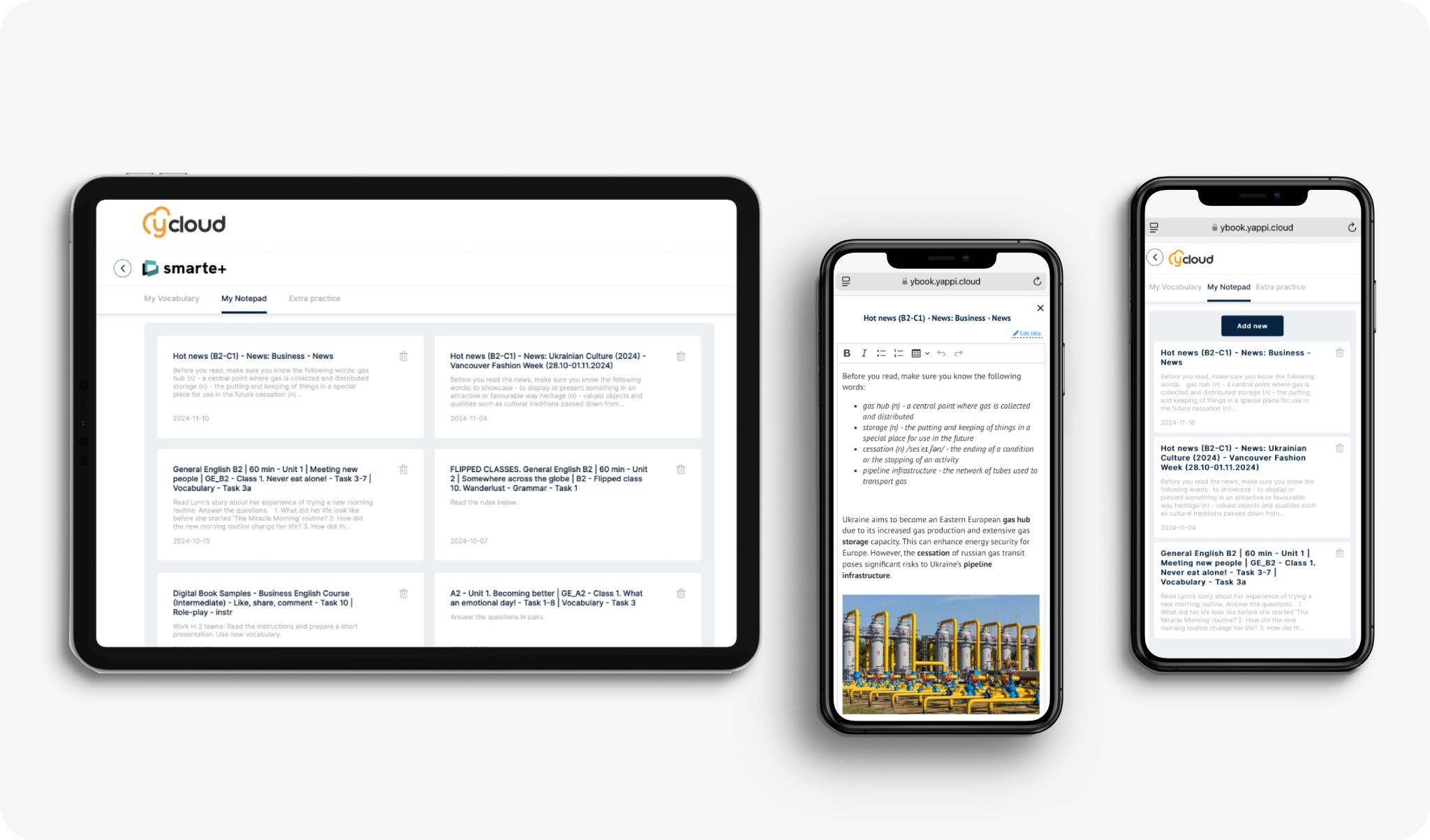
At YAPPI, this need led to the development of its own yCloud ecosystem — a CRM system, a personal student dashboard, and a mobile app all in one. In real time, an HR manager can see who is attending lessons, who is falling behind, and the reasons for absences. Students get access to materials and the ability to practice asynchronously, between sessions. Meanwhile, the teacher sees the full picture of the group before each lesson and can adapt the program on the fly.

Another separate and highly debated topic today is the use of artificial intelligence. AI has already changed corporate learning on several levels at once. It helps adapt teaching materials to a specific industry faster. For example, fintech English or medical terminology used to take months to develop — now the timelines have shrunk significantly. AI-based tools provide extra practice between lessons, give instant feedback on grammar and pronunciation, and let students study at any moment, even during a walk or lunch break.
But there's a flip side too. “AI has made basic English almost freely accessible — anyone can open ChatGPT and study on their own. But self-motivation doesn't work well. People need people. It's about a real commitment — a teacher you don't want to let down by skipping a lesson. AI isn't perceived as a role model and doesn't provide the live interaction that remains the core value of a corporate course,” Kateryna notes.
It's also worth mentioning that, despite the large-scale shift online, demand for offline learning hasn't disappeared entirely. A number of office-based companies want English specifically offline, as part of their corporate culture and a shared, in-person team experience.
Companies' requirements have changed dramatically, and this shift shows up in every detail — from the structure of the program to the choice of topic for a specific lesson.
A typical brief used to sound something like: “We need English for our employees, various levels, preferably offline and inexpensive.” Today the conversation is different.
Kateryna explains: “Companies don't come to us for a B2 level — they come for a result tied to a specific need: our sales managers need to close deals in English, our team is entering the EU market and needs to negotiate, our CTO (or another C-level exec) speaks at international conferences and needs confidence when communicating.”
In other words, the request has shifted from a generic “learn English” to “solve a specific business problem through language.” This means growing demand for English for Specific Purposes — negotiations, pitching products in Western markets, legal English, writing technical documentation, and preparing for talks at international conferences.
Among the specific requests growing fastest:
“Relevant content is no longer a nice-to-have — it's practically a requirement. The program has to be about their business, their situations, and their problems,” Kateryna emphasizes.
“Highly qualified specialists who previously didn't have to communicate directly with clients now have to. They may know the grammar, but they're afraid to speak up in meetings. What matters to companies is that people simply start talking and can easily present their services to a client.”
Corporate English training has moved from a teacher-centered model (where the teacher explains and the student listens and does exercises) to a learner-centered approach (where the student talks more than they listen, and the teacher acts as a facilitator of real communication).
On the methodology level, this means less theory in its pure form and more simulation of real-life situations. A lesson is built around a specific task (holding negotiations, writing an email, presenting a product, discussing a difficult situation with a client), while grammar and vocabulary are absorbed organically along the way.
At the same time, microlearning and spaced repetition are becoming the standard. Short 15–20 minute sessions between main lessons, spaced vocabulary repetition, and asynchronous practice on the platform — all of this helps maintain progress even amid blackouts, air-raid alerts, and chronically overloaded schedules. The Micro Class format is gaining popularity — combining independent work on the platform with short sessions with a teacher. For example, YAPPI offers the Book a Micro Class feature — the ability to book a 30-minute individual speaking lesson with a teacher on any topic from the yBook textbook.
Another particular challenge is the emotional context, since employee fatigue is a factor that directly affects learning.
“The war means blackouts, air-raid alerts, relocations, hybrid teams spread across several time zones. Corporate training has to take the mental state of employees into account and adapt to it through shorter lessons and a gentler pace — without losing sight of learning outcomes and goals,” Kateryna notes.
Among the requests companies now make are: engaged, lively teachers, the ability to reschedule lessons without penalties, and recorded sessions for those who missed class due to an air-raid alert.
Attention to so-called Emotional Intelligence in language has also grown — the ability to express empathy and support a conversation about difficult times without crossing professional boundaries. Companies have noticed that shared lessons help synchronize a team scattered across the world, and have become one of the few spaces that offer a sense of control over the future.
The role of the live teacher isn't shrinking in this context — it's transforming. AI covers routine practice and basic feedback. The teacher, meanwhile, focuses on live interaction, cultural context, understanding subtext, support in difficult communicative situations, and working with each student's individual error patterns.
The corporate English market is changing faster than ever before. YAPPI sees several key shifts already underway that will accelerate in the coming years.

“Everyone has already learned to write with AI's help. But speaking with confidence remains the main ask for negotiations, presentations, and small talk in an international team. That's something you can't delegate to an algorithm,” Kateryna emphasizes.
“The live teacher will become a coach focused on nuance, leadership communication, and everything an algorithm can't feel,” Kateryna believes.
Companies that want measurable results are looking for a partner — someone who will help build a system around their specific business goals, adapt to changes within the team, and provide transparent analytics for L&D and leadership.
Before signing a contract with a provider, it's worth asking five questions:
The answers to these questions will immediately show whether the provider understands the specifics of corporate training in 2026, or is simply selling English courses with a nice presentation.
If you'd like to find out which program is right for your team, contact us, and we'll put together a format tailored to your goals and budget.